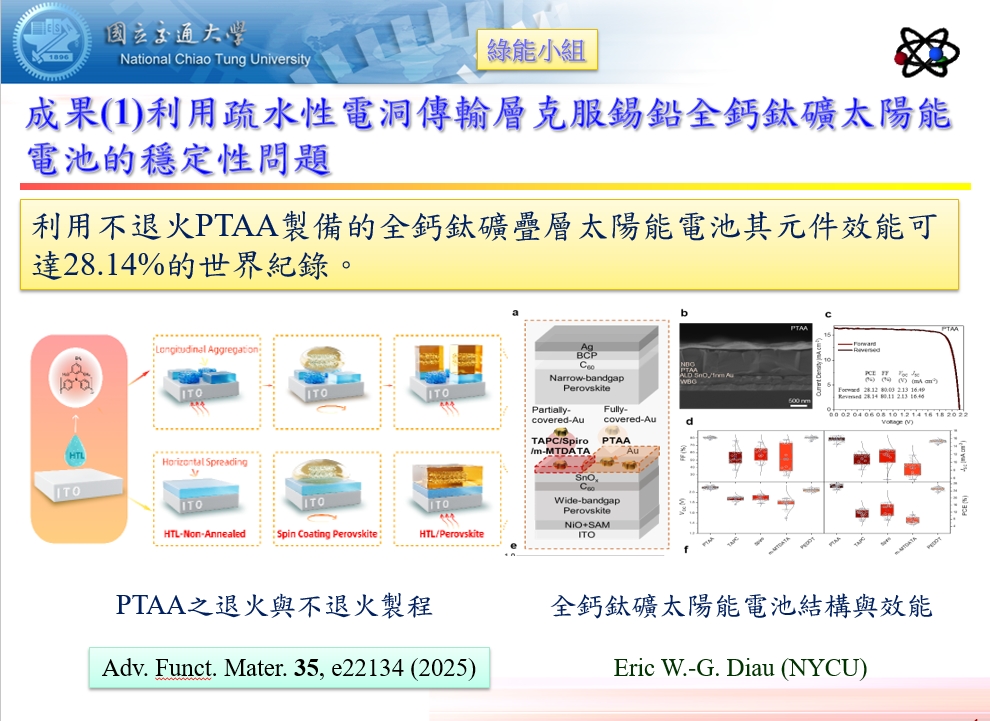
Overcoming the Stability Issue for Hydrophobic Hole Transporting Layers Utilized in Tin-Lead Perovskite and Tandem Solar Cells
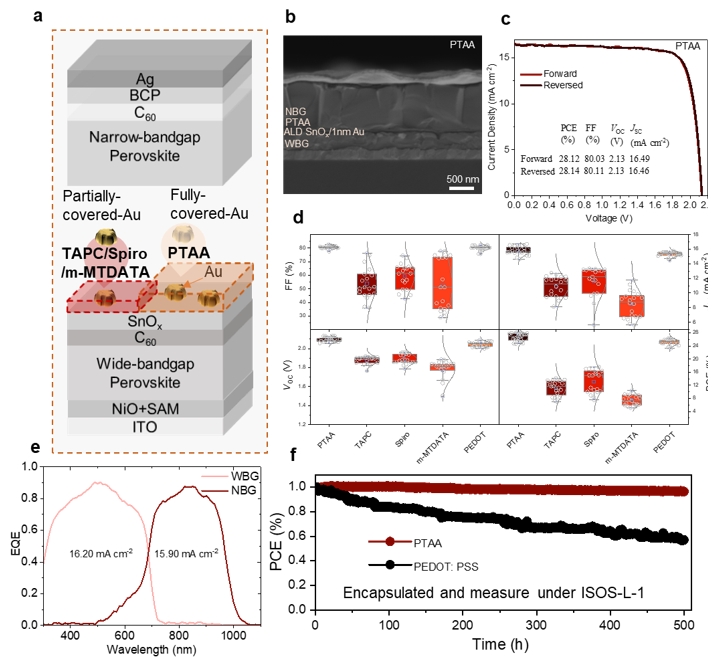
All perovskite tandem solar cells have been fabricated using PTAA as hole-transport material to attain power conversion efficiency 28.14%, a new world record for PTAA-based all perovskite tandem solar cells. We introduce a non-annealing approach to fabricate high-quality PTAA films, which enables the formation of a dense and uniform perovskite layer.2We found SnF2 incorporating to the perovskite precursor promotes the horizontal spreading of PTAA, facilitates the formation of dangling bonds between N and Sn, and enhances π-π interactions combined with SnF2-induced crosslinking. These results highlight the scientific advancements enabled by SnF2, which acts as both a chemical crosslinker and structural/electronic modifier.2This work provides critical insights into HTL design, paving the way for high-efficiency, and stable perovskite solar cells, and advancing their potential for future commercialization.
Chun-Hsiao Kuan, Xianyuan Jiang, Qilin Zhou, Xin Wen, Sung-Fu Hung, Hsin-Lung Chen, Yun-Sheng Shih, Sudhakar Narra, Mingyu Ma, Jau-Wern Chiou, Jhih-Min Lin, Yi Hou,* and Eric Wei-Guang Diau*, “Overcoming the Stability Issue for Hydrophobic Hole Transporting Layers Utilized in Tin-Lead Perovskite and Tandem Solar Cells”, Adv. Funct. Mater. 2025, 35, e22134.