Research Topics
Next-Generation Solar Cells
Research Background (Perovskite Solar Cells)
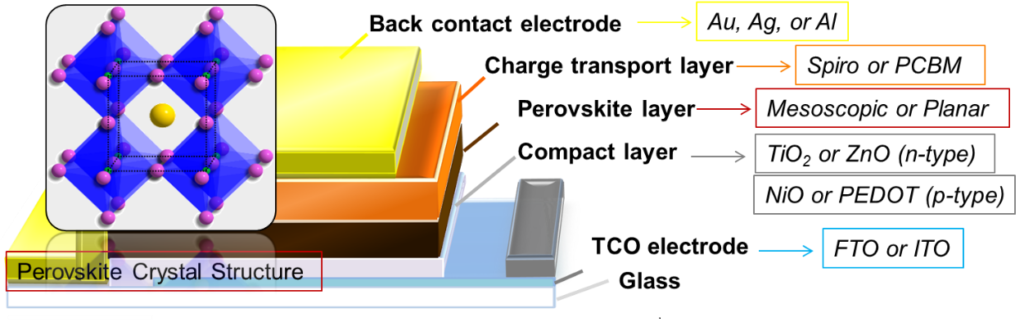
The impact of global warming and our ever-increasing demand for energy insist that traditional sources of energy based on fossil fuels must be replaced by clean and renewable energy. Solar energy is obviously one of the most promising, abundant and attractive sources that might even replace fossil fuels in the near future. Among various novel photovoltaic techniques that have been developed to harvest solar energy and to convert it efficiently into electricity, perovskite solar cells have attracted enormous attention because their performance has so rapidly improved, so as to have become comparable with that of commercial silicon solar cells. Many scientists and engineers have devoted much effort to investigate perovskite solar cells (PSC) of various types as promising next-generation solar cells. Perovskite, which was named after a Russian mineralogist, implies a type of structure of a crystal that conforms to a chemical formula ABX3, of which the optical and optoelectronic properties are readily tunable on varying species A, B or X. The best known PSC is made of methylammonium lead triiodide (A = CH3NH3, B = Pb, X = I) for which an efficiency of power conversion over 22 % has been reported. As shown in the following figure, the PSC device can be constructed like a dye-sensitized solar cell (DSSC) with a mesoscopic heterojunction configuration, or like a thin-film solar cell with an n-i-p or p-i-n planar heterojunction configuration.
碳電極介觀多孔性鈣鈦礦太陽能電池
本實驗室將碳電極應用在鈣鈦礦太陽能電池,在傳統介觀多孔性的元件結構基礎下,我們用碳電極取代了貴金屬電極(Au/Ag),並利用CH3NH3PbI3鈣鈦礦自身優越的電荷傳輸特性取代有機電洞或電子傳輸材料,其元件結構如下圖所示,其電池元件組成為FTO/dense-TiO2/m-TiO2-perovskite/ m-Al2O3-perovskite/Carbon,其中多孔性二氧化鈦(m-TiO2)與碳電極分別為電子與電洞傳輸材料,多孔性二氧化鋯(m-Al2O3)則為兩材料間的阻隔層,避免二氧化鈦上的電子和碳電極上的電洞結合。碳電極鈣鈦礦元件的結構簡單、材料成本低廉,其製程又以單一的網印法為主,深具商業化的潛力,但目前參與研究的團隊較少,本實驗室以低溫慢速結晶的方式製作的元件效率最高可達15 %,為目前文獻報導中的最高紀錄,其結果已發表在著名期刊J. Mater. Chem. A。